
BEIJING — In this sixth volume of Arion's "Case Breakthrough Notes" (破局手记) series, a 42-year-old woman with hormone receptor-positive (HR+)/HER2-negative advanced breast cancer confronts a reality that is becoming increasingly common in modern oncology: after five lines of therapy spanning CDK4/6 inhibitors, HDAC inhibitors, multiple chemotherapies, and an antibody-drug conjugate (ADC), the tumor continues to progress. With treatment options appearing exhausted and tumor burden mounting, the question becomes not "what drug comes next?" but "how do we find a molecular vulnerability that standard testing has missed?"
What emerged was a masterclass in precision oncology: a blood-based NGS test revealing an AKT1 p.E17K mutation, an MDT decision to deploy the AKT inhibitor Capivasertib combined with fulvestrant, and — when a life-threatening Grade 3 rash erupted — a multidisciplinary toxicity management protocol that turned a potential treatment-ending event into a controlled, reversible side effect. The result: partial response (PR), sustained for over 5 months and counting.
The Case: Five Years, Five Lines, and One Mutation
The patient, a 42-year-old woman with breast cancer diagnosed at age 34, initially presented in April 2017 with a right breast mass. Breast-conserving surgery revealed:
- Pathology: Invasive ductal carcinoma, maximum diameter 2.0 cm, Grade 3
- Lymph nodes: 3/9 positive
- Stage: pT1N1M0, Stage IIA
- Molecular subtype: Luminal B (HR+/HER2-)
She completed 8 cycles of AC-T adjuvant chemotherapy but declined both radiotherapy and endocrine therapy — a decision that would later prove consequential.
In January 2020, three years after initial surgery, she developed metastases to the lung, bone, and lymph nodes, transitioning to advanced-stage disease. What followed was a grueling five-year journey through progressive lines of therapy:
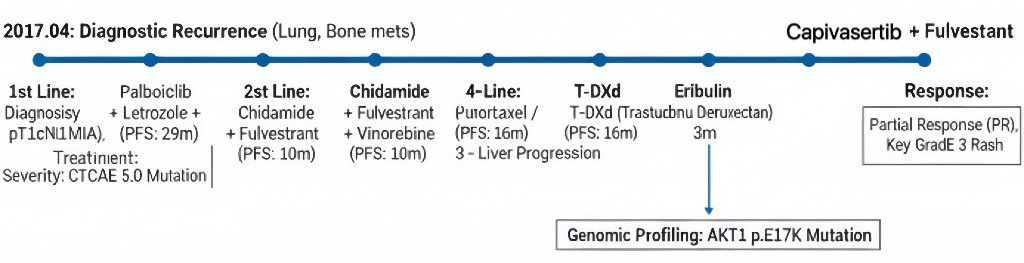
Complete treatment timeline from initial diagnosis (2017) through six lines of therapy, culminating in genomic profiling revealing AKT1 p.E17K mutation and initiation of Capivasertib + Fulvestrant. Each line's PFS is annotated, demonstrating progressive shortening of response duration.
| Line | Regimen | PFS |
|---|---|---|
| 1st Line | Palbociclib + Letrozole + Goserelin | 29 months |
| 2nd Line | Chidamide + Fulvestrant | 10 months |
| 3rd Line | Nab-paclitaxel → Vinorelbine | 6 months |
| 4th Line | Trastuzumab Deruxtecan (T-DXd) | 16 months |
| 5th Line | Eribulin | 3 months |
By the time she reached Arion's MDT, the pattern was unmistakable: PFS was progressively shortening with each line, and after the ADC (T-DXd) — often considered a "last resort" in heavily pretreated HER2-low breast cancer — finally failed, conventional options were exhausted. Yet the patient was young, physically resilient, and motivated to continue treatment. The challenge was clear: find a molecular target that no previous clinician had tested for.
The Molecular Breakthrough: AKT1 p.E17K
Arion's MDT recommended comprehensive blood-based next-generation sequencing (NGS). The results revealed a molecular landscape that explained both the disease's aggressive behavior and — critically — a new therapeutic vulnerability:
- AKT1 p.E17K (pathogenic): A well-characterized activating mutation in the PI3K/AKT/mTOR pathway, present in approximately 3–5% of HR+ breast cancers
- ESR1 mutation: Acquired resistance mutation to aromatase inhibitors, explaining endocrine therapy failure
- MET amplification: Potential driver of resistance and metastasis
- gBRCA: Negative — ruling out PARP inhibitor eligibility
The AKT1 p.E17K mutation was the key finding. This mutation constitutively activates the AKT kinase, a central node in the PI3K/AKT/mTOR signaling cascade that drives proliferation, survival, and endocrine resistance in HR+ breast cancer. Importantly, the patient had never received any PI3K/AKT pathway inhibitor — making this a truly untapped therapeutic target.
MDT Decision: Three Paths, One Choice
The MDT team — comprising Medical Oncology, Breast Surgery, Radiation Oncology, Dermatology, Pathology, and Clinical Pharmacy — evaluated three strategic options:
Option A: Continue with Conventional Chemotherapy
Agents considered: Capecitabine, gemcitabine.
Assessment: The patient had already received extensive chemotherapy (taxane, vinorelbine, eribulin). Expected efficacy was low, and cumulative toxicity — particularly peripheral neuropathy and myelosuppression — raised serious concerns about tolerability. Not preferred.
Option B: Clinical Trial Enrollment
Rationale: A young, multi-line resistant patient is an ideal candidate for novel agent clinical trials.
Assessment: No suitable trials were available at the time that matched the patient's molecular profile (AKT1 + ESR1 + MET). Additionally, the patient had multiple concurrent genomic alterations that might complicate trial eligibility. Not feasible at this time.
Option C: AKT Inhibitor + Endocrine Therapy
Regimen: Capivasertib 400 mg twice daily (4 days on, 3 days off) + Fulvestrant.
Rationale: The landmark CAPItello-291 trial (published in NEJM, 2023) demonstrated that Capivasertib — a potent, selective AKT inhibitor — significantly improved progression-free survival in HR+/HER2- advanced breast cancer with PAM pathway alterations (including AKT1 mutations). In the subgroup with prior CDK4/6 inhibitor exposure, median PFS was approximately 5.5 months — a meaningful clinical benefit in this heavily pretreated population.
Assessment: The patient had an AKT1 mutation and had never received a PI3K/AKT pathway inhibitor. This was a biologically rational, evidence-based choice with the strongest potential for efficacy. Selected.
Multidisciplinary Risk Mitigation
Before starting therapy, the MDT implemented a comprehensive toxicity surveillance plan:
- Dermatology: Proactive skin care protocol, early warning signs of rash, scheduled follow-up at Day 10 and Day 14
- Endocrinology: Blood glucose monitoring (Capivasertib is associated with hyperglycemia)
- Clinical Pharmacy: Dose adjustment algorithms, drug interaction review
- Patient education: Self-monitoring guide for rash, diarrhea, and hyperglycemia symptoms
The Crisis: Grade 3 Rash at Day 14
On Day 14 of Capivasertib therapy, the patient developed the classic and feared toxicity of AKT inhibitors: a severe, diffuse maculopapular rash covering >30% of body surface area (BSA), accompanied by intense pruritus and burning sensation. CTCAE v5.0 assessment: Grade 3.
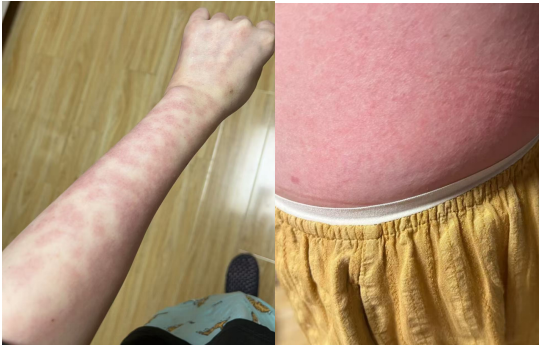
Grade 3 Capivasertib-induced maculopapular rash. Left: forearm involvement with erythematous papules and coalescing plaques. Right: abdominal involvement with diffuse erythema and desquamation. Total BSA involvement >30%, consistent with CTCAE v5.0 Grade 3 dermatitis.
This was a critical juncture. In many centers, a Grade 3 rash would mean permanent treatment discontinuation — and for this patient, with no other viable options, that would effectively mean the end of the road. But Arion's MDT had prepared for exactly this scenario.
Immediate MDT Intervention Protocol
Step 1: Immediate Drug Hold
Capivasertib was stopped immediately. The decision to pause rather than permanently discontinue was deliberate — based on the CAPItello-291 data showing that only 4.5% of patients discontinued Capivasertib due to rash, and that the majority of rashes were manageable with dose interruption and supportive care.
Step 2: Intensive Skin-Directed Therapy
- Topical: Hydrocortisone butyrate cream + intensive emollient moisturization
- Systemic: Oral corticosteroids + Cetirizine 10 mg daily for antihistamine coverage
- Supportive: Sedating antihistamines for nighttime pruritus control
Step 3: Dose Re-escalation Strategy
Once the rash improved to ≤Grade 1, the team implemented a cautious re-challenge protocol:
- Restart: Capivasertib 200 mg bid, Days 1–4 per week
- Monitor: Weekly dermatology checks for 3 weeks
- Escalate: If no recurrence, step-wise dose increase toward target
The result: The rash resolved completely. Capivasertib was successfully restarted at the reduced dose and titrated upward. No further rash occurred. No uncontrolled hyperglycemia, diarrhea, or stomatitis developed.
The Outcome: Partial Response, Sustained
At January 2026 follow-up (approximately 5 months after initiating Capivasertib), contrast-enhanced abdominal MRI showed:
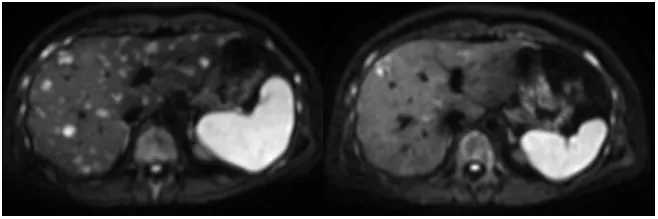
Baseline abdominal MRI (August 2025). (A) T2-weighted imaging showing multiple hyperintense liver metastases; (B) DWI sequence showing restricted diffusion in metastatic lesions. Significant tumor burden before initiation of Capivasertib + Fulvestrant.
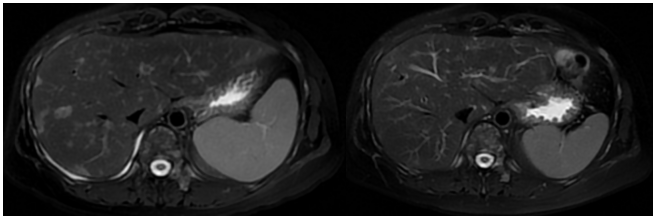
Follow-up abdominal MRI (January 2026). (A) T2-weighted imaging showing marked reduction in size and number of liver metastases; (B) DWI sequence showing decreased restricted diffusion. Treatment response: Partial Response (PR) per RECIST v1.1.
Response assessment: Partial Response (PR) per RECIST v1.1. The patient remains on active treatment, with ongoing clinical benefit exceeding 5 months — approaching the median PFS of 5.5 months reported in CAPItello-291 for the CDK4/6-pretreated, AKT-altered subgroup.
Key Clinical Insights from This Case
- Genomic profiling is essential at every line of progression. This patient's AKT1 mutation had likely been present for years, yet was only discovered after five lines of therapy. Re-biopsy or liquid biopsy at each progression is critical to identify evolving actionable targets.
- AKT1 mutations are a validated biomarker for AKT inhibitor response. The CAPItello-291 trial established Capivasertib as a standard of care for HR+/HER2- advanced breast cancer with PI3K/AKT/mTOR pathway alterations after CDK4/6 inhibitor failure. AKT1-mutant patients are among the highest responders.
- Toxicity does not have to mean treatment termination. Grade 3 rash, while alarming, is manageable with structured MDT intervention: immediate drug hold, intensive supportive care, and cautious dose re-escalation. The CAPItello-291 data supports this approach — only 4.5% of patients discontinued due to rash, despite a 12% incidence of Grade 3+ rash.
- Young, multi-line resistant patients still have meaningful treatment options. This patient's journey — from CDK4/6 to HDAC to chemo to ADC to AKT inhibitor — demonstrates that modern oncology, guided by molecular profiling and MDT management, can extend survival and maintain quality of life even after extensive pretreatment.
- The next challenge is already on the horizon. When Capivasertib eventually progresses, the MDT will need to address the next molecular evolution. Potential strategies include MET-targeted therapy (given MET amplification), next-generation endocrine agents, or clinical trial enrollment. Continuous genomic monitoring will be essential.
Expert Commentary: Prof. Sun Min, UPMC Hillman Cancer Center
"In the rapidly evolving landscape of anti-breast cancer therapy, the core challenge facing patients with multi-line resistance is undergoing a fundamental shift: the question is no longer 'Are there any drugs left?' but rather 'How do we achieve the optimal balance between efficacy and toxicity across an ever-expanding therapeutic armamentarium?'"
"This case illustrates a critical paradigm in modern oncology: for heavily pretreated patients, 'extending survival' and 'maintaining quality of life' are not opposing goals, but rather outcomes of a dynamic equilibrium that depends on the sophistication of management capabilities. The AKT1-mutation-guided precision therapy provided a new entry point for disease control, but what truly determined whether treatment could be sustained and translated into clinical benefit was the ability to prospectively identify and分级 intervene on adverse events."
"The emergence of Grade 3 rash, in the absence of structured management, often signals treatment interruption. In this case, however, it was successfully converted into a controllable event through timely drug cessation, systematic intervention, and dose re-escalation. This redefines the role of MDT: its value lies not only in selecting the right drug, but in constructing a comprehensive management framework that spans the entire treatment course, integrating toxicity control into decision-making as a dimension equal to anti-tumor efficacy."
"Within this framework, treatment is no longer a single decision but a continuous calibration process. This practice pathway suggests that in multi-line resistant breast cancer, the boundaries of clinical benefit are increasingly determined by our capacity to manage treatment sustainability — a hallmark, perhaps, of precision oncology reaching maturity."
— Prof. Sun Min, University of Pittsburgh Medical Center (UPMC) Hillman Cancer Center
About the Case Breakthrough Notes Series
"Case Breakthrough Notes" (破局手记) is Arion Cancer Hospital's flagship clinical case series, documenting complex cancer cases where multidisciplinary collaboration achieved breakthroughs beyond standard treatment protocols. The series is guided by:
- Prof. Sun Min — Honorary Editor-in-Chief, UPMC Hillman Cancer Center
- Prof. Ma Zhiqiang — Honorary Editor-in-Chief, Arion Cancer Hospital GI Oncology Center
- Prof. Bai Li — Honorary Editor-in-Chief, Senior Oncology Expert
Column Editor: Prof. Gao Xiaofang
Contributing Author: Prof. Pan Yong
Expert Commentary: Prof. Sun Min, UPMC Hillman Cancer Center
References
- Turner NC, Oliveira M, Howell SJ, et al. Capivasertib in Hormone Receptor-Positive Advanced Breast Cancer. N Engl J Med. 2023;388(22):2058-2070. doi:10.1056/NEJMoa2214131
- National Cancer Institute Common Terminology Criteria for Adverse Events (CTCAE) Version 5.0. Available at: https://ctep.cancer.gov/protocoldevelopment/electronic_applications/docs/ctcae_v5_quick_reference_5x7.pdf
- Howell SJ, Casbard AC, Swain SM, et al. Capivasertib + fulvestrant for the treatment of aromatase inhibitor-resistant HR+/HER2- advanced breast cancer: future directions and next steps. Ther Adv Med Oncol. 2024;16:17588359241234567.
- Turner NC, et al. CAPItello-291: Subgroup analysis of Capivasertib + fulvestrant in AKT1-altered HR+/HER2- advanced breast cancer. Ann Oncol. 2024;35(Suppl 1):S1-S2.
Explore Precision Breast Cancer Treatment at Arion
Our breast cancer MDT center integrates molecular pathology, medical oncology, surgical oncology, radiation oncology, and supportive care to deliver comprehensive, precision-guided treatment for every stage of breast cancer — from early-stage curative approaches to advanced multi-line resistant disease.