
BEIJING — In this challenging case — the fourth volume of Arion's "Case Breakthrough Notes" (破局手记) series — a 67-year-old woman presented with extensive-stage small cell lung cancer (ES-SCLC) carrying one of the highest tumor burdens imaginable: a 6.1 cm primary lung mass, liver metastases, spleen metastases, brain metastases, and widespread lymph node involvement. With a 5-year survival rate of only 1–5% for ES-SCLC, the odds were overwhelming. Yet through two multidisciplinary tumor board (MDT) discussions, quadruplet systemic therapy, staged precision radiation, and novel maintenance with lurbinectedin + durvalumab, the patient achieved stable disease with a progression-free survival (PFS) exceeding 7 months — far surpassing traditional treatment outcomes.
The Case: A Storm of Metastases
The patient, a 67-year-old woman with a 40-year smoking history and 30-year hypertension, presented with a constellation of alarming findings:
- Right upper lung mass: 6.1 × 5.5 cm, hypermetabolic on PET-CT
- Spleen metastasis: 6.8 × 6.6 cm mass
- Brain metastases: Bilateral frontal lobe lesions
- Lymph node metastases: Mediastinal (3A, 4R) and hilar nodes
- Tumor markers: CEA 539 ng/mL, ProGRP (gastrin-releasing peptide precursor) 3,605 pg/mL
- Pathology: Small cell neuroendocrine carcinoma, Ki-67 80%
- Stage: cT3N2M1, Stage IVB (extensive stage)
With ECOG performance status of 1 and multiple comorbidities, this was the definition of a high-tumor-burden, poor-prognosis case — the kind where standard chemotherapy often fails within months.
First MDT: Choosing the Quadruplet
The MDT team — comprising Medical Oncology, Radiation Oncology, Lung Cancer Center, Diagnostic Radiology, Nuclear Medicine, Pathology, and Interventional Radiology — convened to address two critical questions:
Question 1: Should we add anti-angiogenic therapy to first-line immunochemotherapy?
The standard first-line regimen for ES-SCLC is chemotherapy + PD-L1 inhibitor. However, the ETER701 trial had recently demonstrated that adding the anti-angiogenic agent anlotinib to this backbone — creating a "quadruplet" of etoposide + carboplatin + durvalumab + anlotinib — significantly improved both PFS and overall survival (OS). Subgroup analysis specifically showed benefit in high-tumor-burden, multi-metastatic patients, with no new safety signals.
Decision: Adopt the quadruplet regimen — etoposide + carboplatin + durvalumab + anlotinib. The rationale: anti-angiogenic therapy improves the tumor microenvironment, enhances immune cell infiltration, and synergizes with immunotherapy to maximize systemic control in a high-burden scenario.
Question 2: When should radiation be introduced?
Meta-analyses have shown that adding consolidative thoracic radiation (cTRT) after chemotherapy + immunotherapy significantly improves OS in ES-SCLC while reducing local recurrence risk, without increasing severe adverse events.
Decision: Staged approach — begin with systemic quadruplet therapy to control widespread disease, then introduce localized radiation to the primary lung lesion, mediastinal nodes, and spleen metastasis once tumors have shrunk or stabilized, minimizing radiation-related toxicity.
First-Line Treatment: Systemic Control
The patient completed 6 cycles of the quadruplet regimen. The course was not without challenges:
- After Cycle 1: Mild leukopenia, managed with granulocyte colony-stimulating factor (G-CSF)
- Carboplatin allergy developed after initial cycles; promptly switched to cisplatin-based regimen (TP)
- Hypertension was well-controlled throughout treatment
The tumor marker response was dramatic:
- CEA: 539 ng/mL → 27.1 ng/mL
- ProGRP: 3,605 pg/mL → 127 pg/mL
Imaging after 4 cycles showed significant shrinkage of both the lung primary and spleen metastasis. After 6 cycles, disease remained stable across all sites.
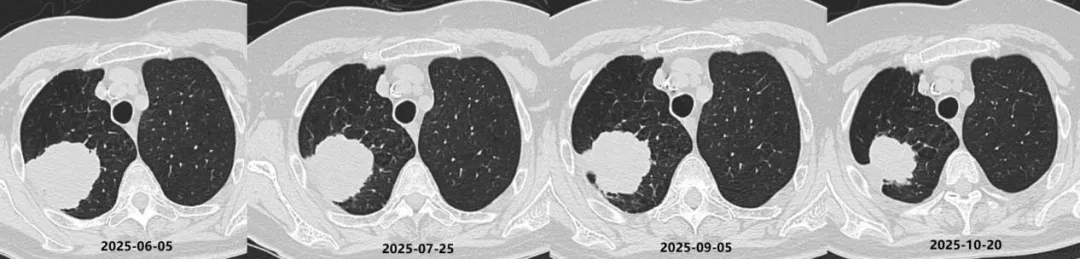
Serial CT scans of the right upper lung primary tumor: June 5, 2025 → July 25, 2025 → September 5, 2025 → October 20, 2025. Progressive shrinkage and cavitation consistent with treatment response.
Local Consolidation: Precision Radiation
Following 6 cycles of systemic therapy, the patient underwent staged radiation:
- Right lung primary + mediastinal nodes: 45 Gy
- Spleen metastasis: 32.5 Gy
Radiation was well-tolerated with only mild thrombocytopenia, managed with thrombopoietin support. No radiation pneumonitis or other severe complications occurred.

Serial CT scans of the spleen metastasis: June 5, 2025 → July 25, 2025 → September 5, 2025 → October 20, 2025. Marked reduction in size and metabolic activity.
Second MDT: Brain Progression and Maintenance Strategy
After completing systemic therapy and local radiation, follow-up MRI revealed enlargement of the right frontal lobe metastasis, accompanied by headache and nausea — brain progression while extracranial disease remained stable.
Question 1: How to manage the brain metastasis?
For ES-SCLC with limited brain metastases (≤3 lesions), stereotactic radiotherapy (SRT) can replace whole-brain radiation therapy (WBRT) with lower neurotoxicity. Given the patient's symptomatic, progressive brain lesion, short-course SRT offered rapid symptom relief while minimizing long-term cognitive damage.
Decision: SRT to the right frontal lobe lesion (27 Gy / 3 fractions), combined with anti-edema and intracranial pressure management. The procedure was completed without complications, and the patient's headaches and nausea resolved promptly.
Question 2: How to optimize maintenance therapy?
The IMforte trial had recently demonstrated that adding lurbinectedin — a novel selective small cell lung cancer chemotherapy agent — to durvalumab maintenance significantly extended both PFS and OS compared to immunotherapy alone, with a 46% reduction in disease progression risk.
Decision: Lurbinectedin + durvalumab combination maintenance therapy, targeting the patient's high tumor burden and propensity for rapid progression with a synergistic approach.
Maintenance and Outcome
The patient completed SRT without adverse events, then initiated lurbinectedin + durvalumab maintenance. After 2 cycles:
- Brain lesion: Stable
- All extracranial lesions: Stable
- Tumor markers: Sustained at low levels
- Symptoms: Resolved, ECOG 0
Current status: PFS exceeding 7 months from diagnosis — a remarkable achievement for high-burden ES-SCLC, where traditional chemotherapy typically yields median PFS of 4–5 months. The patient remains in active follow-up with excellent quality of life.
Key Clinical Insights
- Quadruplet therapy is a viable option for high-tumor-burden ES-SCLC. The addition of anti-angiogenic therapy to standard immunochemotherapy enhances systemic control, improves the tumor microenvironment, and is supported by Level 1 evidence — with manageable toxicity.
- Staged radiation optimizes the "systemic control + local eradication" strategy. By sequencing systemic therapy first to shrink tumors, then applying radiation to residual disease, we maximize local control while minimizing radiation-related toxicity in a vulnerable patient.
- Combination maintenance with lurbinectedin + durvalumab extends remission. For patients with aggressive, high-burden disease, maintenance therapy must be more than immunotherapy alone. The addition of a novel, SCLC-selective agent provides sustained tumor suppression.
- MDT is the cornerstone of complex lung cancer management. Two MDT discussions, each integrating the latest clinical trial evidence with the patient's individual disease biology and treatment response, enabled precise decision-making at every critical juncture.
Expert Commentary: Prof. Zhang Shucai, Beijing Chest Hospital
"This case of high-tumor-burden ES-SCLC fully demonstrates the core value of the MDT model in complex oncology management. The patient presented with multi-organ metastases, significant comorbidities, and aggressive tumor biology — yet through two evidence-based MDT discussions, the team designed a 'quadruplet induction + staged radiation + combination maintenance' strategy that achieved tumor stability, symptom relief, and excellent safety, with a PFS far exceeding traditional outcomes."
"The quadruplet regimen rapidly controlled systemic disease, creating the conditions for subsequent local radiation. Staged radiation then eradicated residual disease in the lung, mediastinum, and spleen. When brain progression occurred, SRT provided rapid symptom control with minimal neurotoxicity. Finally, lurbinectedin + durvalumab maintenance sustained the remission."
"This case provides a practical paradigm for similar patients. Looking ahead, the management of such challenging cases must move toward greater precision — using biomarkers to individualize combination therapy selection, exploring synergies between different mechanisms of action, and conducting more targeted clinical trials to ultimately improve outcomes for these difficult-to-treat patients."
— Prof. Zhang Shucai, Beijing Chest Hospital (Capital Medical University Affiliated)
About the Case Breakthrough Notes Series
"Case Breakthrough Notes" (破局手记) is Arion Cancer Hospital's flagship clinical case series, documenting complex cancer cases where multidisciplinary collaboration achieved breakthroughs beyond standard treatment protocols. The series is guided by:
- Prof. Sun Min — Honorary Editor-in-Chief, UPMC Hillman Cancer Center
- Prof. Ma Zhiqiang — Honorary Editor-in-Chief, Arion Cancer Hospital GI Oncology Center
- Prof. Bai Li — Honorary Editor-in-Chief, Senior Oncology Expert
Column Editor: Prof. Gao Xiaofang
Contributing Author: Prof. Zhang Min
Expert Commentary: Prof. Zhang Shucai, Beijing Chest Hospital
Explore Advanced Lung Cancer Treatment at Arion
Our lung cancer MDT center brings together thoracic surgery, medical oncology, radiation oncology, and interventional radiology to deliver comprehensive, evidence-based care for the most challenging lung cancer cases — including ES-SCLC with high tumor burden and multiple metastases.