
BEIJING — In the second volume of Arion's "Case Breakthrough Notes" (破局手记) series — edited by Prof. Sun Min (UPMC), Prof. Ma Zhiqiang, and Prof. Bai Li — an 80-year-old male patient presented with a devastating convergence of conditions: stage IV ascending colon cancer (pT4bN2M1) that had penetrated the bowel wall and invaded the right liver lobe, complete bowel obstruction causing massive abdominal distension, severe anemia with hemoglobin at 67 g/L, and life-threatening coronary artery disease with 50%–99% stenosis of the right coronary artery. Every surgical textbook would label this case as "operable at prohibitive risk." Arion's MDT team decided to prove otherwise.
The Case: A Triple-Threat Emergency
The patient arrived at Arion with a one-year history of intermittent abdominal pain, recently worsened by bloody stools and two weeks of complete constipation. His baseline condition was already fragile:
- Age: 80 years old with ECOG performance status of 2
- Nutrition: BMI 20.38 kg/m² (underweight), albumin 26.9 g/L (severe hypoalbuminemia)
- Hemoglobin: 67 g/L — severe anemia with active tumor bleeding
- Heart: Prior myocardial infarction, right coronary artery 50%–99% stenosis, moderate aortic regurgitation
- Tumor: 5.0 × 4.5 cm ascending colon mass with liver invasion, retroperitoneal lymph node metastasis
- Emergency: Complete bowel obstruction with upstream colonic dilation, imminent perforation risk
The dilemma was brutal: do nothing and the patient dies from obstruction, perforation, or hemorrhage within weeks. Operate and the cardiac stress of surgery could trigger fatal arrhythmia, myocardial infarction, or heart failure intraoperatively. The question was not whether to operate — but how to make surgery survivable.
The MDT Assessment: Every Voice Matters
Arion's real-time full-term MDT convened immediately, bringing together the GI Oncology Center, Anesthesiology, Cardiology, ICU, Radiology, and Interventional Ultrasound teams. The debate was intense:
Anesthesiology & ICU: The patient was "walking on the edge of a cliff." Right coronary near-occlusion meant any hemodynamic fluctuation during surgery could precipitate fatal ischemia. Preoperative anemia correction was non-negotiable — the heart needed every oxygen-carrying capacity it could get.
Surgery: Tumor invasion into the liver meant a simple colostomy would not stop bleeding or tumor progression. A radical right hemicolectomy with partial hepatectomy was the only option for meaningful survival, but the surgical time and blood loss would stress an already compromised cardiovascular system.
The MDT reached a consensus: "Bridge first, operate second." Convert an emergency operation into an elective one by buying time through preoperative optimization.
Phase 1: The Bridge — Buying Time to Save a Life
Before surgery could even be contemplated, the team had to transform the patient's physiology from "actively dying" to "survivable candidate."
Step 1: Nasojejunal Decompression. A transnasal intestinal obstruction catheter was placed, successfully decompressing the massively distended proximal colon and draining accumulated fecal matter. This immediately reduced intra-abdominal pressure, improved diaphragmatic excursion, and relieved the physiological stress on the cardiovascular system.
Step 2: Anemia Correction. Four units of packed red blood cells were transfused, raising hemoglobin from 67 g/L to 84 g/L. For a patient with severe coronary disease and active bleeding, maintaining adequate oxygen delivery to the myocardium was critical. The team also initiated intravenous iron supplementation to rebuild iron stores.
Step 3: Nutritional Support. With albumin at 26.9 g/L, the patient was in a catabolic state with impaired wound healing capacity. Intensive nutritional support was provided to optimize protein synthesis and immune function before the surgical insult.
Phase 2: The Operation — Precision Under Pressure
On November 13, 2025, with the patient stabilized, the surgical team proceeded to the operating room under continuous hemodynamic monitoring.
The procedure: Laparoscopic right hemicolectomy with partial hepatic resection — a minimally invasive approach that reduced surgical trauma compared to open surgery. The operative findings confirmed the severity of the case: the tumor was densely adherent to the liver capsule, requiring meticulous dissection to protect the duodenum and major vascular structures. The liver invasion was resected en bloc with the colon specimen.
Key achievement: Total intraoperative blood loss was kept to 100 mL — a remarkable figure for a multi-organ resection in a patient with coagulopathy. This minimal blood loss was crucial in preventing the hemodynamic instability that could have precipitated cardiac events.
The final pathology: ulcerated moderately-to-poorly differentiated adenocarcinoma with focal mucinous features, pT4bN2M1, with R0 resection margins (negative margins) on both the colonic and hepatic specimens.
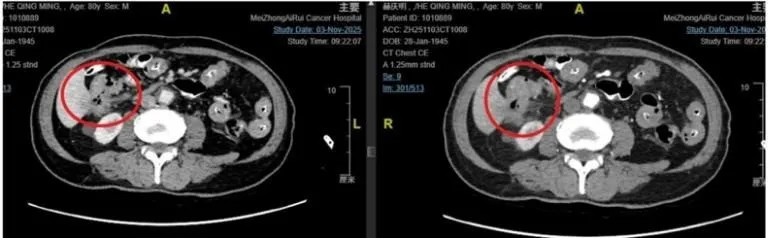
Preoperative CT imaging reveals the ascending colon tumor (red circle) invading the right hepatic lobe — a T4b lesion with synchronous liver metastasis.
Phase 3: The Second Battle — Postoperative Complications
With surgery complete, the MDT team's work was far from over. The patient's immunocompromised, elderly state proved fertile ground for a cascade of postoperative complications:
1. Hepatorenal Space Abscess
Postoperative imaging revealed a 70 mL fluid collection in the right hepatorenal recess with rising inflammatory markers. Under ultrasound guidance, the interventional team performed precise percutaneous drainage. Combined with targeted antibiotics, the abscess resolved without requiring reoperation.
2. Deep Vein Thrombosis
Ultrasound detected a left superficial femoral artery thrombus — a dangerous finding in a postoperative patient where anticoagulation risks bleeding from the fresh surgical site. The MDT navigated this delicate balance with carefully titrated low-molecular-weight heparin (enoxaparin Q12h), monitoring closely for both thrombus progression and wound hematoma. Serial ultrasounds confirmed no new thrombus formation.
3. COVID-19 Infection
During recovery, the patient tested positive for SARS-CoV-2. In an elderly, postoperative, immunocompromised patient, this could have been catastrophic. The infectious disease team immediately initiated nirmatrelvir/ritonavir (Paxlovid) antiviral therapy. The patient remained stable, and the infection did not progress to severe pneumonia.
Outcome and Follow-Up
Against all odds, the patient recovered:
- Bowel function: Restored, transitioned from nil per os to liquid diet to regular diet
- Hemoglobin: Stabilized at 96 g/L, no further transfusion requirements
- Infection: Abscess resolved, inflammatory markers normalized
- Thrombosis: No extension, no pulmonary embolism
- COVID-19: Resolved without respiratory deterioration
- Discharge: Home with ambulatory follow-up plan
At three-month postoperative follow-up, the patient was recovering well with preserved functional status. The next phase — adjuvant chemotherapy tailored to cardiac tolerance — was being planned.
"This is exactly the type of case that surgeons dread — 80 years old, T4b colon cancer with complete obstruction, and severe coronary disease that pushes the case into the 'absolute contraindication' zone. The breakthrough was not in the surgery itself, but in the strategic patience of the MDT team: the bridge therapy (nasogastric decompression + anemia correction) converted an uncontrolled emergency into a controlled elective procedure. That is where lives are saved."
— Prof. Wang Xishan, National Cancer Center / Cancer Hospital, Chinese Academy of Medical Sciences
"From an evidence-based medicine perspective, this case required a quantitative risk-benefit analysis. Option A (palliative stoma only) offered median survival of 2–8 months with uncontrolled bleeding and transfusion dependence. Option B (radical resection) carried 15%–25% perioperative mortality but offered meaningful survival and quality of life for survivors. The 2024 AHA/ACC guidelines provide the framework for this multi-modal approach. The Arion MDT's clinical judgment was validated — the patient not only survived surgery but recovered well enough to consider adjuvant therapy."
— Prof. Sun Min, UPMC Hillman Cancer Center
Key Takeaways
- Age and comorbidity are not absolute contraindications to radical cancer surgery. With proper preoperative optimization and MDT coordination, even octogenarians with severe cardiac disease can undergo curative-intent resection.
- Bridge therapy transforms emergency into opportunity. Converting an emergency operation into a planned elective procedure by correcting anemia, decompressing the bowel, and optimizing nutrition dramatically reduces perioperative risk.
- Perioperative management is as important as the surgery itself. Postoperative complications (infection, thrombosis, COVID-19) in elderly patients require the same multidisciplinary vigilance as preoperative planning. The operation is only half the battle.
- Minimally invasive surgery reduces physiological stress. Laparoscopic approach with meticulous hemostasis (100 mL blood loss) minimized cardiac strain in a patient with critical coronary stenosis.
About the Case Breakthrough Notes Series
"Case Breakthrough Notes" (破局手记) is Arion Cancer Hospital's flagship clinical case series, documenting complex cancer cases where multidisciplinary collaboration achieved breakthroughs beyond standard treatment protocols. The series is guided by:
- Prof. Bai Li — Honorary Editor-in-Chief, Senior Oncology Expert
- Prof. Sun Min — Honorary Editor-in-Chief, UPMC Hillman Cancer Center
- Prof. Ma Zhiqiang — Honorary Editor-in-Chief, Arion Cancer Hospital GI Oncology Center
Case contributors: Dr. Liu Zheng (Arion GI Oncology Center), with expert commentary by Prof. Wang Xishan (National Cancer Center, Chinese Academy of Medical Sciences) and Prof. Sun Min (UPMC).
Explore Advanced Cancer Treatment at Arion
Our MDT team specializes in complex, high-risk cancer cases that other institutions may consider inoperable. Contact us for a remote consultation or in-person evaluation.