Editor's Note
For cancer patients, standardized treatment is often a race against time. Yet during treatment, the true threat to life is not always the tumor itself — it may be a sudden, critical emergency condition.
This case shares the story of a nearly 70-year-old patient with early-stage laryngeal cancer. Just as he was about to begin concurrent radiotherapy combined with targeted therapy, he developed persistent abdominal pain, distension, vomiting, and other signs of acute abdomen. What made this case particularly deceptive was that the patient had no prior abdominal surgical history whatsoever. Faced with this complex presentation, Beijing Arion Cancer Hospital immediately activated its MDT multidisciplinary consultation mechanism. Through close observation, dynamic assessment, and stepwise treatment, the team keenly identified a condition that is easily missed yet potentially life-threatening — internal hernia — and promptly performed emergency surgery, successfully avoiding severe complications such as bowel necrosis and buying precious time for the patient's subsequent standardized laryngeal cancer treatment.
This was not only a life-saving race against time, but also a lesson worth every doctor's and patient's attention: Absence of abdominal surgery history does not mean internal hernia cannot occur; conservative treatment may succeed, but only under the close supervision of an experienced surgical team with emergency surgical capability on standby at all times. For cancer patients, only a medical team with comprehensive multidisciplinary rescue capabilities can achieve seamless coordination between tumor treatment and sudden emergencies, providing truly continuous, safe, and precise full-course medical services.
Patient Profile
Mr. Wang (pseudonym), a nearly 70-year-old man, developed unexplained hoarseness six months ago, occasionally accompanied by cough and sputum production. Examination confirmed a right-sided tongue base cyst and vocal cord mucosal lesion. He underwent suspensory laryngoscopic partial laryngectomy + tongue base mass excision. Postoperative pathology confirmed glottic laryngeal carcinoma T1aN0M0, Stage I — an early-stage laryngeal cancer with a relatively favorable overall prognosis.
The patient then presented to our hospital for local radiotherapy combined with targeted therapy, completed radiotherapy simulation, and was scheduled to begin concurrent targeted radiotherapy one week later.
| Parameter | Details |
|---|---|
| Age/Sex | Nearly 70-year-old male |
| Primary Diagnosis | Glottic laryngeal carcinoma, T1aN0M0, Stage I |
| Initial Procedure | Suspensory laryngoscopic partial laryngectomy + tongue base mass excision |
| Planned Next Step | Concurrent radiotherapy + targeted therapy (scheduled within 1 week) |
| Abdominal Surgical History | None |
Phase 1: Acute Abdomen Strikes on the Eve of Cancer Treatment
On the weekend just before the standardized laryngeal cancer treatment was set to begin, the patient developed persistent abdominal pain and distension, accompanied by nausea, vomiting, and other discomfort. Considering the patient's advanced age, relatively weak physical function, and limited tolerance, our hospital team immediately initiated multidisciplinary diagnosis and treatment, completed abdominal CT examination and blood tests to rapidly identify the cause and clarify the condition while providing symptomatic treatment to relieve discomfort.

The abdominal CT results did not allow the team to relax their vigilance. Imaging revealed small-bowel edema and exudation in the right lower quadrant. Combining imaging features with physical examination findings, the team first ruled out common causes of acute abdomen such as appendicitis, cholecystitis, and pancreatitis. But what was causing the intestinal edema?
While analysis of the patient's condition continued, the medical team instituted symptomatic supportive treatment including NPO (nothing by mouth), intravenous fluid replacement, and anti-infective therapy, closely monitoring urine output, abdominal signs, and vital indicators throughout, dynamically tracking changes in the condition to buy sufficient time for subsequent diagnostic and therapeutic decisions.
Phase 2: Activating MDT Multidisciplinary Consultation — A Stepwise Treatment Plan
The patient had a known diagnosis of early laryngeal cancer with a malignant disease history, and now presented with an acute abdomen — a complex situation with high diagnostic and therapeutic difficulty. A single department could not simultaneously address both the underlying oncologic condition and the acute surgical emergency. To ensure precise, safe, and standardized care, our hospital immediately activated the MDT multidisciplinary joint consultation mechanism, integrating experts from the Radiation Oncology Center, Gastrointestinal Tumor Center, Interventional Center, and Radiology Center for a joint consultation.
After comprehensive multidisciplinary assessment, the patient had passage of flatus and stool, no peritoneal irritation signs, and inflammatory markers improved after anti-inflammatory treatment — temporarily lifting the alarm for emergency surgery. However, given the patient's advanced age and multiple comorbidities, the consultation team remained highly vigilant and could not rule out the rare possibility of internal hernia despite the absence of any prior abdominal surgical history.
What Is Internal Hernia?
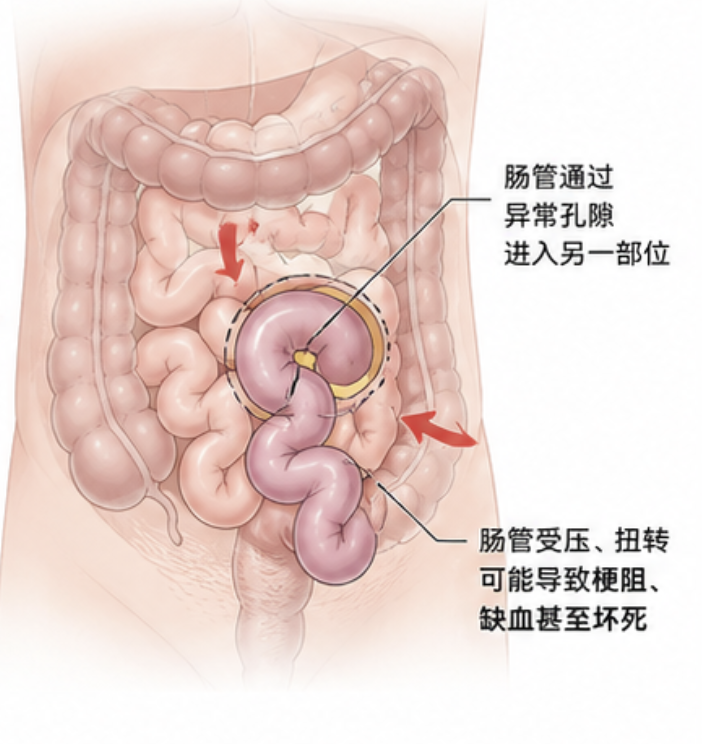
Internal hernia refers to a condition in which a segment of intestine passes through an abnormal or congenitally existing gap or defect within the peritoneal cavity into an abnormal location, leading to intestinal compression, obstruction, and potentially intestinal strangulation and necrosis — a form of acute abdomen. Although internal hernias formed after abdominal surgery are more common, individuals without any abdominal surgical history can still develop internal hernias due to congenital peritoneal defects, mesenteric defects, or other anatomical anomalies.
Internal hernias often present acutely, with symptoms including paroxysmal severe abdominal pain, nausea, vomiting, abdominal distension, and cessation of flatus and stool. Because early symptoms lack specificity and CT scans do not always yield a definitive diagnosis, misdiagnosis or delayed treatment can easily occur. Once intestinal strangulation develops, bowel necrosis and perforation can ensue within a short time — potentially becoming life-threatening.
While active surgical management and observation continued, Dr. Liu Tao, Director of the Interventional Center, proposed a treatment plan involving intestinal obstruction catheter placement with negative-pressure drainage, rapidly draining accumulated gas and fluid from the intestinal lumen, reducing intraluminal pressure, and effectively relieving abdominal distension and pain.
After thorough multidisciplinary deliberation and comprehensive assessment, President Ma Zhiqiang, leading the surgical treatment team, finalized a stepwise diagnostic and therapeutic plan: first proceed with interventional catheter decompression, anti-infective therapy, fluid and nutritional support to effectively control symptoms, while closely monitoring changes in the condition throughout, remaining ready to proceed to surgery at any moment based on the patient's recovery trajectory.
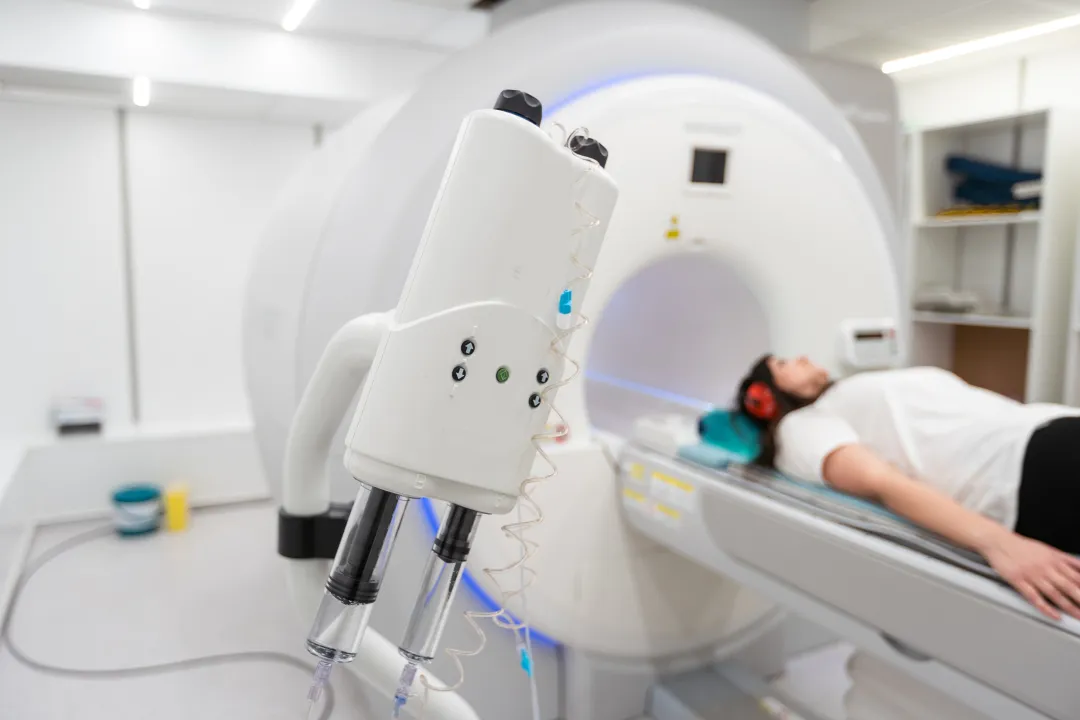
After active treatment, the patient's symptoms did not show significant improvement. The team was fully aware that if conservative treatment failed, immediate surgical intervention would be necessary. The multidisciplinary team immediately ordered a repeat CT scan, which soon revealed increased intraperitoneal exudate and dilated small bowel. Through CT image three-dimensional reconstruction technology, radiologist Dr. Guo Zhiyan assisted the surgical team in identifying the key etiology: the patient's ileum was in an abnormal position, highly suspicious for internal hernia. The MDT team conducted another urgent re-evaluation and confirmed that the patient now met indications for emergency surgical exploration. Preoperative preparations were completed immediately, laying the foundation for emergency surgery and seizing the optimal treatment window.
Phase 3: Emergency Surgery Resolves Crisis — Safeguarding Subsequent Treatment
Built upon the MDT team's precise judgment and thorough preoperative preparation, under the guidance of President Ma Zhiqiang, our hospital's gastrointestinal surgery team led by Director Liu Zheng and Director Xie Jiangping performed an emergency exploratory laparotomy for the patient. Intraoperative meticulous exploration of the abdominal cavity finally confirmed the etiology: internal hernia. However, due to timely surgical intervention, the bowel had not yet developed ischemic necrosis. The surgical team completely released the internal hernia, achieving complete success — avoiding fatal complications such as bowel necrosis and septic shock, maximally protecting the patient's abdominal organ function, and preserving favorable physical conditions for the subsequent standardized and continuous treatment of his early laryngeal cancer.
Postoperatively, the medical team formulated a refined rehabilitation protocol for the patient, continuing NPO status with fluid replacement, anti-infective therapy, nutritional support, and dynamic electrolyte monitoring, while closely tracking vital signs and postoperative recovery throughout. At present, the patient's recovery status is good: acute abdomen symptoms such as abdominal pain and distension have completely resolved, inflammatory markers have gradually returned to normal range, and the problems of intestinal obstruction and intraperitoneal infection have been thoroughly resolved. The patient's physical condition has essentially recovered, all indicators have stabilized, and he has been smoothly transferred back to the Radiation Oncology Center to formally commence subsequent laryngeal cancer radiotherapy treatment.
Key Takeaways
1. Internal Hernia Is Not a Trivial Matter — It Can Occur Without Prior Surgery
Patients without surgical history can still develop internal hernias. Some patients whose bowel has not yet undergone strangulation, ischemia, or necrosis may experience spontaneous reduction after conservative treatment such as NPO status, gastrointestinal decompression, and fluid replacement, achieving symptom relief and thereby avoiding surgery. However, the course of internal hernia often progresses very rapidly — bowel re-incarceration can occur within a short time, even advancing to intestinal ischemia and necrosis. Therefore, close monitoring by an experienced multidisciplinary team is essential.
2. During Observation, Surgeons Must Continuously Assess Multiple Parameters
Throughout the observation period, surgeons need to continuously evaluate changes in abdominal pain, abdominal physical signs, vital signs, laboratory markers, and imaging findings. Once persistent severe abdominal pain, peritoneal irritation signs, elevated inflammatory markers, or signs suggestive of intestinal ischemia or necrosis appear, immediate surgical intervention should be performed.
3. MDT Is the Backbone of Managing Complex Oncologic Emergencies
As a tertiary specialized cancer hospital, Beijing Arion Cancer Hospital not only delivers precise standardized diagnosis and treatment for various cancers but also possesses the capability to rapidly manage emergent critical illnesses and various complications in cancer patients — effectively breaking through the limitations of single-specialty care. Relying on close multidisciplinary collaboration, individualized precision assessment, and a stepwise refined rescue model, our hospital successfully completed this emergency rescue of an elderly patient with complex comorbidities. While safeguarding the patient's life, we maximally preserved the conditions for continued tumor treatment. With professional, rigorous, and comprehensive medical services, Beijing Arion Cancer Hospital provides full-course health protection for cancer patients throughout their journey.
Seek Expert Second Opinion for Complex Cancer Cases
If you or your loved one faces a complex oncology diagnosis — especially when complicated by non-oncologic emergencies such as acute abdomen, obstruction, or other surgical conditions — Beijing Arion Cancer Hospital's multidisciplinary tumor board can provide a comprehensive treatment evaluation. Our integrated MDT approach ensures seamless coordination between cancer treatment and emergency surgical care.
Request Consultation →WhatsApp: +86 17742026990 | Email: info@healthtourchina.net