BEIJING — In this seventh volume of Arion's "Case Breakthrough Notes" (破局手记) series, we confront a scenario that is becoming increasingly common as populations age: an 82-year-old man with newly diagnosed locally advanced gastric poorly differentiated adenocarcinoma, who also carries the burden of chronic renal failure requiring long-term hemodialysis and a history of coronary stent implantation. The clinical question is stark: when standard treatment — surgery, chemotherapy — is too dangerous, what can oncology still offer?
The answer, as this case demonstrates, lies in the power of multidisciplinary teamwork to redefine what is possible. Through careful MDT deliberation, the team selected a non-surgical, non-chemotherapy approach: intensity-modulated radiation therapy (IMRT) at 45 Gy/25 fractions combined with individualized Traditional Chinese Medicine (TCM). The result: partial response (PR) with >50% tumor reduction, complete resolution of bleeding symptoms, and stable disease exceeding 1 year — all without a single Grade 3 or higher adverse event.
The Case: Three Diseases, One Patient
The patient, an 82-year-old man, presented with a 2-month history of gastric malignancy accompanied by hematemesis and melena. Endoscopic evaluation revealed:
- Primary lesion: Elevated tumor in the anterior wall of the gastric antrum, measuring 4 x 4 cm
- Pathology: Poorly differentiated adenocarcinoma
- Second lesion: A separate 1.5 cm elevated lesion in the descending duodenum
Staging (AJCC 8th Edition): cT2-4aNxM0 — locally advanced disease. Imaging suggested the tumor invaded the full thickness of the gastric wall or adjacent structures, with equivocal regional lymph node involvement and no distant metastasis.
The Comorbidity Burden
| Comorbidity | Impact on Treatment |
|---|---|
| Chronic renal failure (dialysis-dependent) | Severely limits cytotoxic chemotherapy options; drug metabolism and clearance compromised |
| Post-coronary stent implantation | High perioperative cardiac risk; antiplatelet therapy complicates surgical management |
| Age 82 with diminished physiological reserve | Reduced tolerance to treatment toxicity; higher complication rates |
| Left kidney mass (5-6 year history, stable) | Low-grade or benign; requires monitoring but no active intervention |
PET-CT findings: Hypermetabolic focus in the gastric antrum consistent with malignancy. A mildly hypermetabolic left renal mass, stable over 5-6 years, considered likely low-grade malignant or benign. Bilateral pulmonary micronodules without definitive metastatic features.
The Dilemma: When Every Standard Option Is Contraindicated
The convergence of advanced age, end-stage renal disease, and coronary artery disease created a therapeutic paradox. The tumor was locally advanced and symptomatic (bleeding), demanding intervention — yet the three pillars of standard gastric cancer treatment were each problematic:
- Surgery: The patient's age, renal failure, and cardiac history placed perioperative mortality risk unacceptably high. Postoperative recovery and quality of life would be severely compromised.
- Systemic chemotherapy: Dialysis-dependent renal failure made standard cytotoxic regimens (fluoropyrimidines, platinum, taxanes) unsafe. The risk of severe myelosuppression, nephrotoxicity, and infection was prohibitive.
- Targeted/immunotherapy: Insufficient molecular profiling data at presentation; renal function constraints further limited options.
MDT Deliberation: Four Paths, One Decision
The MDT team — comprising Gastrointestinal Surgery, Radiation Oncology, Traditional Chinese Medicine (external), Nephrology (external), and Radiology — conducted a thorough risk-benefit analysis of four potential treatment paths:
Option A: Radical Surgery
Assessment: Given the patient's advanced age, renal failure, and coronary artery disease, the surgical team determined that perioperative mortality and severe complication rates far exceeded potential benefits. Postoperative quality of life would likely deteriorate significantly. Not recommended.
Option B: Systemic Chemotherapy ± Targeted Therapy
Assessment: Advanced age and dialysis-dependent renal failure significantly increased risks of chemotherapy-induced myelosuppression, nephrotoxicity, and infection. The metabolic and clearance challenges of cytotoxic agents in a dialysis patient made this approach unsafe. Not recommended.
Option C: Radiation Therapy Alone
Assessment: Could provide local control of the gastric primary lesion and rapid relief of bleeding symptoms. However, it would not address the duodenal lesion or potential micrometastatic disease. As a standalone approach, it was insufficient. Insufficient as monotherapy.
Option D: Radiation Therapy + Traditional Chinese Medicine (Selected)
Rationale: Radiation would control the local gastric lesion and stop bleeding, while TCM would provide systemic regulation, support vital energy (qi) and yin, resolve stasis, and clear toxicity — reducing radiation side effects and enhancing the patient's overall tolerance. This integrative approach aligned with the therapeutic goal for elderly, multi-comorbidity patients: "living with the tumor while maintaining quality of life."
Left kidney lesion strategy: Given its 5-6 year stability, the MDT unanimously agreed that the left kidney mass required no active intervention — only continued surveillance. Selected.
Multidisciplinary Perspectives
- GI Surgery: While the tumor was technically resectable by staging criteria, the patient's severe comorbidities made surgical risk far outweigh benefit. Recommended non-surgical management.
- Nephrology: Advised enhanced fluid balance management during radiotherapy to avoid volume overload. Confirmed left kidney lesion was stable; supported continued observation.
- Radiology: Noted the left kidney mass had low metabolic activity and long-term stability, consistent with benign or low-grade behavior — biologically distinct from the gastric malignancy.
- TCM: Proposed a treatment principle of "supplementing qi, nourishing yin, resolving stasis, and clearing toxicity" to reduce radiation adverse effects and enhance the body's resilience.
- Radiation Oncology: Confirmed the gastric antrum lesion was suitable for precision radiotherapy and could serve as the primary modality for local control.
The Treatment: Precision IMRT + Individualized TCM
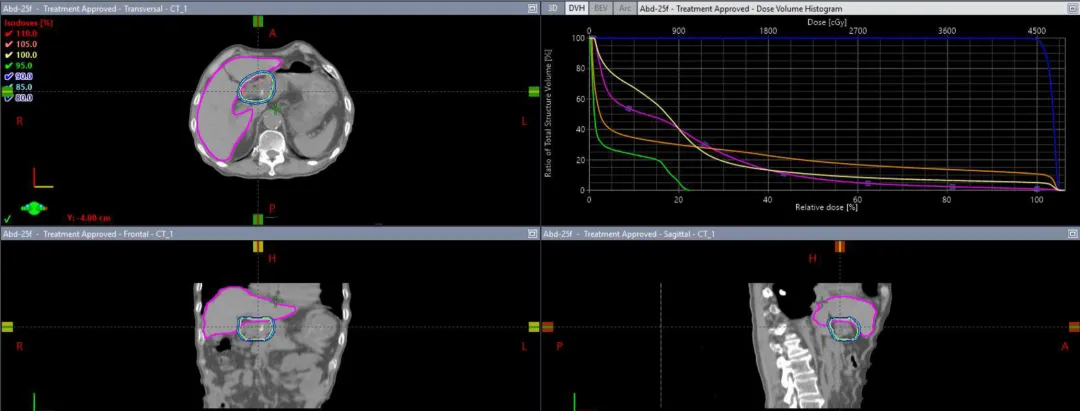
Intensity-Modulated Radiation Therapy (IMRT) plan for the gastric antrum lesion. Total dose: 45 Gy in 25 fractions (5 fractions/week). The plan precisely covers the target volume while strictly constraining dose to both kidneys (especially the left kidney) and small bowel. Image-guided radiotherapy (IGRT) was used for each fraction to correct setup errors and ensure treatment precision.
Radiation Therapy Phase
- Technique: Intensity-Modulated Radiation Therapy (IMRT)
- Total dose: 45 Gy in 25 fractions, 5 fractions per week
- Target: Gastric antrum primary lesion
- Organ-at-risk constraints: Strict dose limitation to both kidneys (especially left kidney) and small intestine
- Positioning: Fasting during simulation and treatment to minimize gastric motion and position uncertainty
- Image guidance: Image-Guided Radiation Therapy (IGRT) performed for each fraction to correct setup errors and ensure precision
Concurrent Traditional Chinese Medicine
Based on TCM syndrome differentiation of "qi-yin dual deficiency with stasis-toxin internal accumulation", treatment was directed at:
- During radiotherapy: Primarily "supporting the correct and expelling the evil" — supplementing qi, nourishing yin, resolving stasis, and clearing toxicity to reduce radiation-induced mucositis, fatigue, and other adverse effects
- Post-radiotherapy: Shifted to "consolidating the root and preventing recurrence/metastasis" as maintenance therapy
- Dosage: One decoction daily, taken throughout the entire treatment course and continuing as maintenance
Supportive Care and Monitoring
- Symptom assessment: Every 2 weeks
- Lab monitoring: Monthly complete blood count, liver function, renal function, and electrolytes
- Left kidney lesion: Abdominal imaging every 6 months
The Outcome: Partial Response and Beyond
Radiotherapy was completed without any Grade 3 or higher adverse events. No acute kidney injury or cardiac function deterioration occurred. Post-treatment follow-up imaging demonstrated remarkable tumor response:
1-Month Post-Radiotherapy Assessment
Gastric MRI showed the antral lesion had decreased by more than 50% compared to baseline — assessed as Partial Response (PR) per RECIST v1.1. The patient's gastrointestinal symptoms (hematemesis, melena) completely resolved, with improved appetite and physical strength.
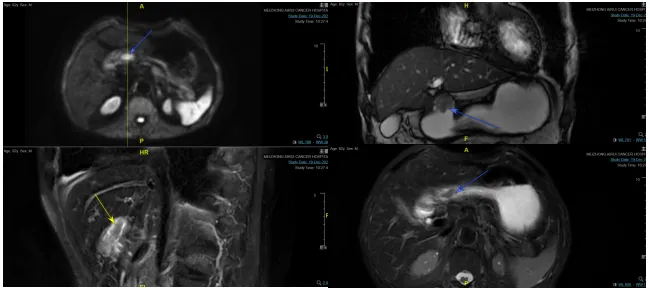
Pre-treatment gastric MRI (T2 fat-suppressed sequence). The gastric antrum tumor (arrow) demonstrates full-thickness wall invasion with a maximum diameter of 4 cm. Baseline imaging before IMRT initiation.
Follow-Up MRI: 6 and 10 Months Post-Treatment
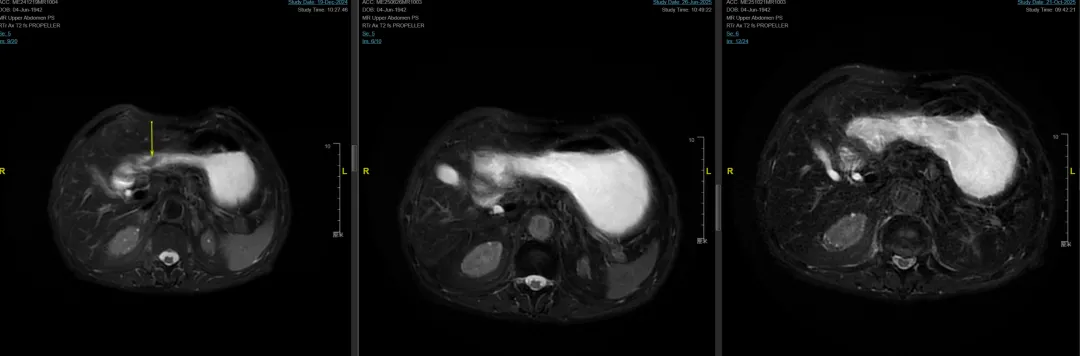
T2 fat-suppressed MRI follow-up series: Pre-treatment (left) — tumor with significant wall thickening and signal abnormality; 6 months post-RT (center) — marked reduction in tumor size and signal intensity; 10 months post-RT (right) — sustained regression with stable residual changes. Progressive tumor shrinkage confirms durable partial response.
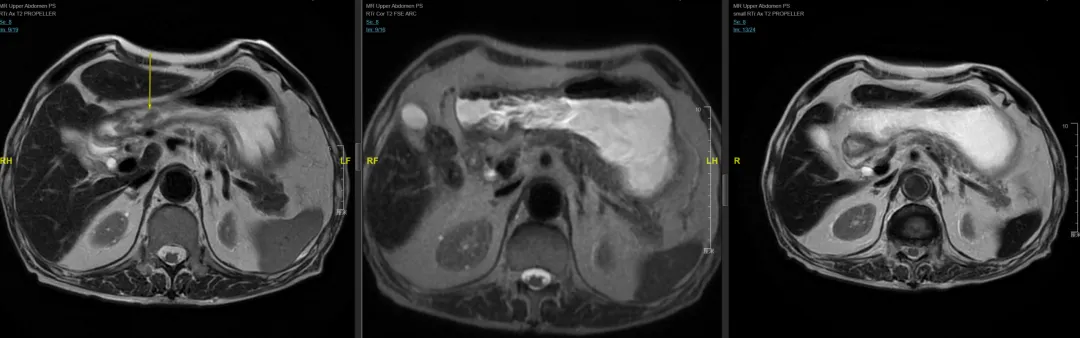
T2 (non-fat-suppressed) MRI follow-up series at the same three time points, corroborating the progressive tumor regression seen on T2FS sequences. Consistent findings across both sequences confirm treatment response durability.
Survival and Functional Status
As of the time of writing, the patient has completed treatment and maintained stable follow-up for over 1 year, with:
- Disease status: No progression — stable disease maintained
- Performance status: KPS 80 (good functional status for an 82-year-old)
- Renal function: Maintained at baseline dialysis-dependent level — no deterioration
- Cardiac status: Coronary disease stable
- Left kidney lesion: Continued stability, no size change
- Quality of life: Good, with preserved independence in daily activities
Ongoing Follow-Up Plan
- Maintenance: Continued individualized TCM, with formula adjustment every 3 months
- Gastric surveillance: Gastroscopy and abdominal MRI every 3 months (monitoring gastric and duodenal lesions)
- Systemic assessment: Every 6 months (including PET-CT if indicated), with concurrent left kidney lesion monitoring
- Pulmonary nodules: Ongoing surveillance for bilateral micronodule changes
Progression Contingency Plans
- If gastric or duodenal lesion progresses: Consider endoscopic local intervention or re-evaluation for second-course radiotherapy
- If distant metastasis develops: Evaluate targeted or immunotherapy based on genomic testing (with careful renal function assessment)
- If left kidney lesion shows progression: Consider interventional or ablative local therapy
Key Clinical Insights from This Case
- Age and comorbidity should not be automatic contraindications to cancer treatment. For elderly patients with multiple comorbidities, treatment decisions should move beyond the traditional "surgery-first" paradigm. A comprehensive risk-benefit assessment — conducted by a true MDT — can identify safe and effective non-surgical paths.
- IMRT offers precision and safety in elderly patients. Intensity-modulated radiotherapy, with its ability to conform dose to the target while sparing adjacent organs, proved to be both effective and remarkably well-tolerated in this 82-year-old patient with renal failure and cardiac disease.
- Traditional Chinese Medicine adds a unique dimension to integrative oncology. In this case, TCM served a dual role: reducing radiation toxicity (mucositis, fatigue) during treatment and providing maintenance therapy to support the body's resilience. The "supporting the correct while expelling the evil" principle translated into tangible clinical benefit.
- The surgeon's role in MDT extends beyond "can we resect?" to "should we resect?" In this case, the surgical team's explicit recommendation against surgery — based on the patient's overall condition — was the critical pivot that redirected the entire treatment strategy toward a non-surgical approach.
- Stable lesions deserve active surveillance, not active intervention. The left kidney mass, stable for 5-6 years, was correctly managed with observation. This "differentiated management" approach — treating what needs treatment and watching what does not — embodies patient-centered individualized care.
- "Living with the tumor" is a valid therapeutic goal. For patients where cure is not the primary objective, achieving prolonged stable disease with preserved quality of life is a meaningful outcome. This patient's >1-year stability at KPS 80 demonstrates that non-curative treatment can still be life-enhancing.
Expert Commentary: Prof. Cai Yong, Peking University Cancer Hospital
"The treatment of elderly patients with malignant tumors differs from that of ordinary adult patients. Whether in guidelines or consensus statements, there are important distinctions, and the fundamental principle is to achieve optimal treatment outcomes under the premise that the patient can tolerate the therapy. Because elderly patients frequently have concomitant diseases, tumor treatment must include a thorough assessment of the patient's systemic tolerance, leading to an individualized treatment plan that suits the patient."
"The treatment of this case was based on precisely this principle, and the correct decision was made. From the perspective of the gastric cancer clinical stage alone, the tumor was resectable. However, because of the serious concomitant diseases, the surgical risk was high, and therefore surgery was abandoned in favor of a more moderate treatment approach combining local radiotherapy with Traditional Chinese Medicine. From the treatment process and outcome, this was the correct choice."
"In clinical practice, we frequently encounter similar patients. We must avoid both overtreatment and excessive conservatism. The former carries high treatment risk — because elderly patients have poor functional reserve across organ systems, and once severe complications arise, they can easily lead to death. The latter amounts to abandoning treatment, shortening the patient's expected survival. The correct approach is to adopt individualized treatment suitable for the patient under multidisciplinary guidance, thereby maximizing the extension of the patient's survival."
— Prof. Cai Yong, Peking University Cancer Hospital (北京大学肿瘤医院)
About the Case Breakthrough Notes Series
"Case Breakthrough Notes" (破局手记) is Arion Cancer Hospital's flagship clinical case series, documenting complex cancer cases where multidisciplinary collaboration achieved breakthroughs beyond standard treatment protocols. The series is guided by:
- Prof. Sun Min — Honorary Editor-in-Chief, UPMC Hillman Cancer Center
- Prof. Ma Zhiqiang — Honorary Editor-in-Chief, Arion Cancer Hospital GI Oncology Center
- Prof. Bai Li — Honorary Editor-in-Chief, Senior Oncology Expert
Column Editor: Prof. Gao Xiaofang
Contributing Author: Prof. Zhao Yaowei
Expert Commentary: Prof. Cai Yong, Peking University Cancer Hospital
References
- National Comprehensive Cancer Network (NCCN) Clinical Practice Guidelines in Oncology: Gastric Cancer. Version 2026.
- Japanese Gastric Cancer Association. Japanese gastric cancer treatment guidelines 2021 (5th edition). Gastric Cancer. 2023;26(1):1-25.
- ASTRO (American Society for Radiation Oncology) guidelines for radiation therapy in gastric cancer.
- World Society of Emergency Surgery (WSES) guidelines on gastric cancer in elderly patients.
- Chinese Society of Clinical Oncology (CSCO) guidelines for integrative medicine in oncology, 2025 edition.
Explore Integrative Gastric Cancer Treatment at Arion
Our Gastrointestinal Oncology MDT center integrates surgical oncology, radiation oncology, medical oncology, Traditional Chinese Medicine, and nephrology to deliver comprehensive, individualized treatment — including for elderly patients and those with complex comorbidities where standard approaches are contraindicated.