
BEIJING — In this eighth volume of Arion's "Case Breakthrough Notes" (破局手记) series, we encounter a tumor type so rare that even experienced oncologists may only see it once in a career: MSI-H (microsatellite instability-high) duodenal mixed carcinoma. Duodenal adenocarcinoma itself accounts for only 1–2% of gastrointestinal malignancies, with a 5-year survival rate of just 10–30%. An MSI-H subtype is even rarer, and the treatment literature is so scarce that standard guidelines offer no specific recommendations.
What unfolded was a masterclass in MDT-driven precision oncology: a 57-year-old woman with locally advanced duodenal cancer, complete obstruction, obstructive jaundice, and severe malnutrition, whose molecular profile revealed MSI-H, PD-L1 CPS=45, and TMB 28.13 muts/Mb — a constellation of biomarkers that screamed "immunotherapy responder." Through a carefully orchestrated sequence of nutritional rehabilitation, dual immunotherapy conversion (ipilimumab + nivolumab), and radical pancreaticoduodenectomy, the team achieved not just R0 resection, but a postoperative pathology that revealed a completely unexpected tumor composition — a twist that would reshape the entire adjuvant treatment plan.
The Case: A Rare Tumor, A Severely Compromised Patient
The patient, a 57-year-old woman, presented with a 2-month history of anorexia and weight loss (8 kg) and 1 month of skin jaundice. She had no history of hypertension, diabetes, or family history of malignancy. At an outside hospital, she underwent percutaneous transhepatic cholangiodrainage (PTCD) for biliary decompression, which successfully lowered her bilirubin levels. Gastroscopy revealed an occupying lesion in the descending duodenum; biopsy confirmed poorly differentiated adenocarcinoma.
Initial Staging and Molecular Profile
PET-CT findings: A round soft-tissue mass in the descending and horizontal duodenum with increased FDG uptake, accompanied by mesenteric lymph node metastasis. No distant metastasis elsewhere.
Pathology (descending duodenum biopsy): Poorly differentiated adenocarcinoma
- CK(+), CK7(+), CK20 (focal +)
- Ki-67: 70%
- Claudin18.2: 2+/3+ (75%)
- HER2: (+)
Genomic testing results:
- MSI-H: 33.33% (PMS2 protein loss)
- PD-L1: CPS = 45
- Mutations: ARID1A, PIK3CA, TP53
Laboratory values on admission:
- Hemoglobin: 96 g/L (anemia)
- Bilirubin: 73.6 umol/L (elevated)
- Albumin: 39.8 g/L (low-normal)
- Prealbumin: 145 mg/L (low)
- CEA: 245 ng/ml (markedly elevated)
- CA19-9: 66 u/ml (elevated)
Upper abdominal contrast-enhanced MRI: Large malignant tumors in the descending and ascending duodenum, with local involvement of the serosal surface and infiltrative changes in the surrounding fat planes; pancreatic duct dilation; biliary drainage tube in place.
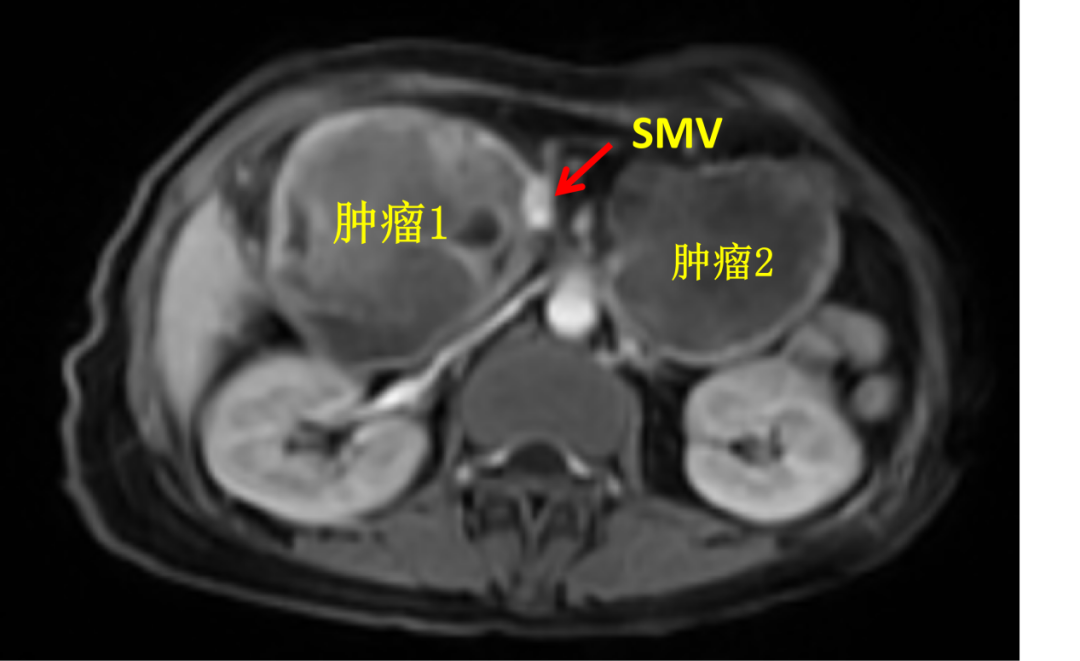
Preoperative abdominal MRI. Two large tumors are visible in the duodenal region: Tumor 1 (larger) and Tumor 2 (smaller). The superior mesenteric vein (SMV) is intimately related to the tumors, indicating the complexity of subsequent surgical resection. The close vascular relationship raised concerns about the feasibility of radical pancreaticoduodenectomy at initial presentation.
Tumor diagnosis: Duodenal adenocarcinoma (T4N+M0, Stage III), with obstructive jaundice, upper gastrointestinal obstruction, anemia, malnutrition, and electrolyte disturbances.
The Core Challenges: Five Competing Crises
- High tumor aggressiveness with extensive invasion: Two tumor lesions, with the descending duodenum lesion showing poorly differentiated adenocarcinoma, high malignancy (Ki-67 70%), serosal invasion (T4), mesenteric lymph node metastasis, and complete duodenal obstruction — creating severe nutritional support challenges.
- Complex anatomical location: The tumor abutted the pancreatic head. The large tumor burden and dual-lesion configuration, with intimate relationship to the superior mesenteric vein (SMV), made subsequent pancreaticoduodenectomy extremely difficult with high risk of incomplete resection.
- Severe nutritional compromise and treatment intolerance: 8 kg weight loss over 2 months, low prealbumin (145 mg/L), hypoalbuminemia, iron-deficiency anemia, and electrolyte disturbances (hyponatremia, hypochloremia) significantly increased perioperative complication risks (anastomotic leak, infection) and made immediate surgery or chemotherapy infeasible.
- Multi-organ dysfunction: Markedly elevated liver function parameters, with biliary obstruction and hepatocellular injury further impairing drug metabolism and tissue repair capacity, limiting treatment options.
- Rare molecular subtype with no established guidelines: MSI-H duodenal adenocarcinoma is extraordinarily rare, with minimal evidence for neoadjuvant immunotherapy — leaving the MDT to draw from MSI-H colorectal cancer data and extrapolate carefully.
MDT Deliberation: Two Critical Questions, One Unified Strategy
The MDT team — comprising Radiology, Nuclear Medicine, Pathology, Hepatobiliary Oncology, GI Oncology, Medical Oncology, and Radiation Oncology — convened to address two fundamental questions:
Question 1: Treatment Sequence — Surgery First or Neoadjuvant Therapy First?
The dilemma: Radical surgery is the cornerstone of curative treatment for locally advanced duodenal cancer. However, the patient's current physical condition and tumor characteristics dramatically increased surgical risk and the probability of incomplete resection. Neoadjuvant systemic therapy, while potentially enabling tumor downstaging, carried the risk of disease progression or complications during treatment, potentially causing loss of surgical opportunity.
MDT decision: The patient's general condition and nutritional status were extremely poor, making immediate surgery inadvisable. Nutritional support for at least 2 weeks was required. Critically, the MSI-H molecular profile indicated a high probability of immunotherapy benefit. Therefore, nutritional support would be combined with immunotherapy, with the goal of achieving tumor downstaging and increasing the probability of radical resection. Referencing the landmark NICHE-2 trial (MSI-H/dMMR colorectal cancer treated with neoadjuvant nivolumab + ipilimumab: 95% major pathological response, 68% pathological complete response), the team selected dual immunotherapy as the conversion strategy.
Question 2: Nutritional Support Strategy
The dilemma: Complete duodenal obstruction made enteral nutrition access extremely difficult, yet prolonged parenteral nutrition carries high complication rates.
MDT decision: Attempt nasojejunal tube placement to establish enteral access, combined with enteral + parenteral nutrition for optimal nutritional improvement.
The Treatment Journey: From Obstruction to R0 Resection
Phase 1: Establish Access and Improve Nutrition
The interventional radiology team successfully placed a nasojejunal feeding tube. Simultaneously, gastric decompression was combined with enteral + parenteral nutrition support to restore fluid and electrolyte balance and correct malnutrition.
Phase 2: Neoadjuvant Dual Immunotherapy
Immunotherapy regimen:
- Cycle 1: Ipilimumab 50 mg + Nivolumab 240 mg
- Cycle 2 (2 weeks later): Nivolumab 240 mg monotherapy
3-week post-treatment assessment:
- CEA: 245 ng/ml → 91 ng/ml (62.9% reduction)
- Gastric decompression output: >1000 ml/day → progressively decreasing
- Patient resumed small oral intake, with significant improvement in general condition
- Abdominal CT: tumor shrinkage — treatment response confirmed
4-week re-assessment and second immunotherapy: Nivolumab 240 mg was administered again. The patient developed a Grade 3 rash, which resolved with symptomatic treatment. Given the confirmed tumor response and the risk of further immunotherapy-related adverse events, the MDT convened again.
Phase 3: Second MDT — Surgery or More Immunotherapy?
Key considerations: Although immunotherapy was effective, continuing carried risk of more severe adverse events. The patient had demonstrated significant improvement in general condition after aggressive nutritional support — liver function parameters were essentially normal, prealbumin and hemoglobin had increased markedly, and the tumor had shrunk to a resectable state. Surgical risk was now within an acceptable range.
MDT decision: Proceed with active preoperative preparation and schedule radical pancreaticoduodenectomy.
Preoperative re-evaluation:
- CEA: 68 ng/ml (continued decline)
- Enhanced MRI: tumor further reduced in size; the tumor-SMV interface was clearer than before, indicating reduced vascular involvement
At 6 weeks after initiating neoadjuvant immunotherapy, the patient underwent radical pancreaticoduodenectomy under general anesthesia. The procedure was uneventful, and the patient recovered well, being discharged at 3 weeks postoperatively.
The Postoperative Surprise: Pathology Rewrites the Diagnosis
The postoperative pathology report revealed a diagnosis that no one — including the preoperative biopsy — had anticipated:
Ampullary Tumor (Original Descending Duodenum Lesion on Imaging)
- Gross: 6.3 × 4.4 × 4.0 cm
- Microscopy: Mixed neuroendocrine-non-neuroendocrine tumor (MiNEN), with extensive necrosis
- Neuroendocrine component: Small cell neuroendocrine carcinoma (~30%)
- Non-neuroendocrine component: Moderately-to-poorly differentiated adenocarcinoma (~70%)
- Cancer tissue invaded the pancreas and duodenal mucosa
Duodenal Ascending Tumor (Separate Lesion)
- Gross: 5.5 × 5.0 × 4.0 cm
- Microscopy: Small cell neuroendocrine carcinoma
- Cancer tissue invaded the full thickness of the bowel wall
Resection Margins and Lymph Nodes
- No vascular or perineural invasion
- All margins negative for cancer: duodenal margin, gastric margin, pancreatic margin, and common bile duct margin
- Lymph nodes: 0/8 positive — pN0
- Peripancreatic: 0/5
- Periduodenal: 0/1
- Station 8A: 0/1
- Station 12P: 0/1
Pathological staging: Ampullary lesion: T4N0M0; Duodenal ascending lesion: T3N0M0. R0 resection achieved.
Postoperative Molecular Confirmation
A14 (Ampullary lesion):
- Syn(+), CgA(-), CD56(+), INSM1(+), P40(-), Ki-67 90%
- HER-2(0), PD-L1 TPS=5%, CPS=30
- MLH1(+), MSH2(-), MSH6(-), PMS2(+)
- Genomic: PIK3CA, PTEN, TP53, ARID1A, PTCH1
- TMB: 28.13 muts/Mb, MSI-H
A15 (Duodenal ascending lesion):
- Syn(+), CgA(+), Ki-67 90%
- PD-L1 TPS=10%, CPS=20
- Genomic: PIK3CA, PTEN, TP53, ARID1A, BRCA2, PTCH1
- TMB: 34.75 muts/Mb, MSI-H
Critical finding: Both lesions were confirmed as MSI-H, with no germline mutations in cancer predisposition genes — ruling out Lynch syndrome.
The Adjuvant Challenge: What Do You Treat When the Pathology Changes?
At 3 weeks postoperatively, the MDT reconvened to address the adjuvant treatment strategy. The postoperative pathology revealed a highly unusual and aggressive tumor type: mixed neuroendocrine-non-neuroendocrine carcinoma with a small cell component. Given the high malignancy of both lesions and the MSI-H molecular profile, the risk of recurrence and metastasis was deemed high.
Adjuvant treatment plan:
- Chemotherapy: EP regimen (Etoposide + Cisplatin), initially planned for 4–6 cycles (to be adjusted based on tolerance and recurrence/metastasis status)
- Immunotherapy maintenance: Given the MSI-H pathology and confirmed neoadjuvant immunotherapy response, nivolumab maintenance for approximately 1 year was planned
Current status: The patient has successfully completed 2 cycles of postoperative adjuvant chemotherapy with good tolerance. Her weight has steadily increased, and her general condition is excellent.
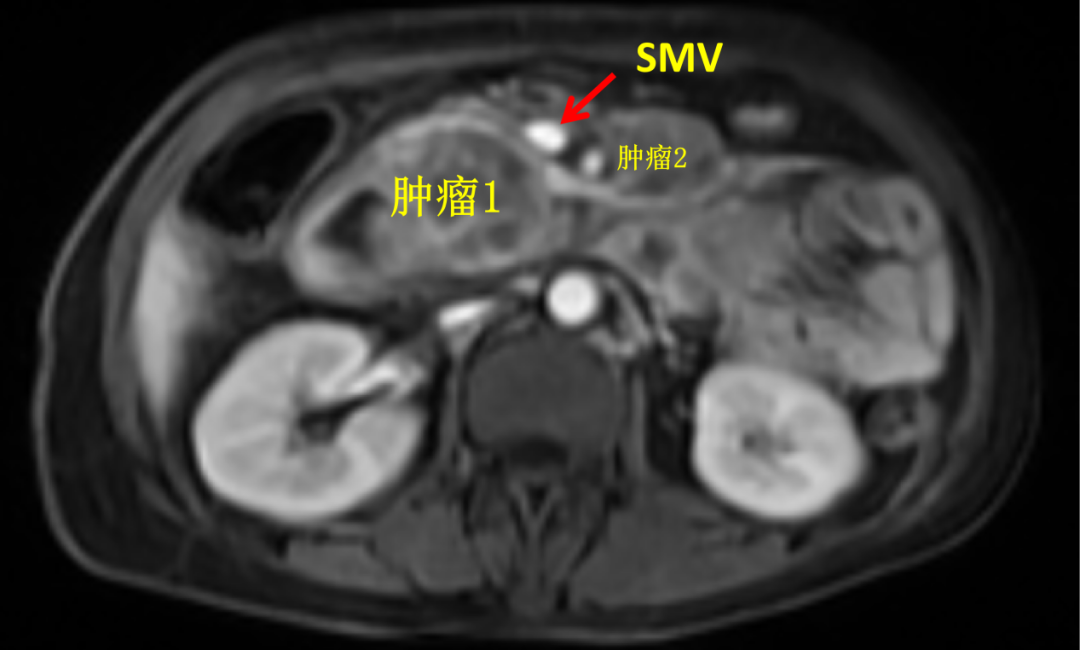
Postoperative follow-up imaging after radical pancreaticoduodenectomy. The surgical bed shows expected postoperative changes without evidence of residual tumor. The patient is on active adjuvant EP chemotherapy with nivolumab maintenance, with excellent tolerance and steadily improving nutritional status.
Key Clinical Insights from This Case
- MSI-H is a powerful biomarker for immunotherapy regardless of primary tumor site. The NICHE-2 trial in MSI-H colorectal cancer demonstrated that neoadjuvant dual immunotherapy (ipilimumab + nivolumab) achieves remarkable pathological responses (95% MPR, 68% pCR). This case extends that paradigm to duodenal cancer — a rare site where no standard neoadjuvant immunotherapy guidelines exist.
- Dual immunotherapy (CTLA-4 + PD-1 blockade) is more effective than monotherapy in highly aggressive tumors. The combination of ipilimumab and nivolumab creates a more robust anti-tumor immune response than single-agent PD-1 inhibition, which is particularly important in high-burden, rapidly proliferating tumors like this one (Ki-67 70%).
- "Conversion therapy" is not just for liver metastases — it applies to locally advanced primary tumors too. The traditional concept of conversion therapy involves downstaging unresectable metastatic disease to resectable. Here, the team applied the same principle to a locally advanced primary tumor that was resectable-in-principle but high-risk-in-practice, converting it to a safer surgical candidate.
- Nutritional rehabilitation is a prerequisite for cancer treatment, not an afterthought. This patient's complete duodenal obstruction and severe malnutrition would have made immediate surgery or chemotherapy lethal. The nasojejunal feeding tube, combined enteral + parenteral nutrition, and meticulous electrolyte management were as critical as the immunotherapy itself.
- Postoperative pathology can completely change the treatment plan. The preoperative biopsy showed only poorly differentiated adenocarcinoma. The postoperative specimen revealed mixed neuroendocrine-non-neuroendocrine carcinoma with a small cell component — an entirely different tumor biology that demanded a different adjuvant strategy (EP chemotherapy + immune maintenance rather than standard adjuvant fluoropyrimidine-based therapy).
- The "full-time MDT" model is essential for rare and complex tumors. This case involved no fewer than 7 specialties across multiple stages: Radiology, Nuclear Medicine, Pathology, Hepatobiliary Surgery, GI Surgery, Medical Oncology, Interventional Radiology, and Nutrition. The continuous MDT collaboration ensured that each decision was made with the fullest possible information.
Expert Commentary: Prof. Xiao Yu, Peking University Third Hospital (PKUTH)
"Duodenal adenocarcinoma has low incidence and high malignancy. MSI-H mixed adenocarcinoma-neuroendocrine carcinoma is particularly rare, and clinical practice lacks standardized treatment protocols. This case — a locally advanced patient with obstruction and severe malnutrition — successfully achieved conversion therapy and radical resection through full-course MDT-guided individualized strategy, offering significant exemplary value."
"The highlights of this case include: First, the selection of dual immunotherapy neoadjuvant treatment based on MSI-H, high PD-L1 CPS, and high TMB, achieving rapid tumor downstaging and symptom improvement. Second, the establishment of enteral nutrition access through nasojejunal tube placement combined with enteral + parenteral nutrition, breaking through surgical contraindications caused by nutritional compromise. Third, timely pancreaticoduodenectomy at 6 weeks post-neoadjuvant therapy, achieving R0 resection. Fourth, the postoperative adjuvant treatment combining EP chemotherapy with immune maintenance therapy, based on the small cell neuroendocrine carcinoma component and MSI-H pathology. The entire decision-making process was scientifically sound and prudent."
"This case confirms that molecular subtyping-guided immune conversion therapy + perioperative nutritional support + full-course MDT management can significantly improve the radical resection rate and safety of complex and rare duodenal cancers, providing a reproducible practical experience for similar cases."
— Prof. Xiao Yu, Peking University Third Hospital (北京大学第三医院)
About the Case Breakthrough Notes Series
"Case Breakthrough Notes" (破局手记) is Arion Cancer Hospital's flagship clinical case series, documenting complex cancer cases where multidisciplinary collaboration achieved breakthroughs beyond standard treatment protocols. The series is guided by:
- Prof. Sun Min — Honorary Editor-in-Chief, UPMC Hillman Cancer Center
- Prof. Ma Zhiqiang — Honorary Editor-in-Chief, Arion Cancer Hospital GI Oncology Center
- Prof. Bai Li — Honorary Editor-in-Chief, Senior Oncology Expert
Column Editor: Prof. Gao Xiaofang
Contributing Author: Prof. Jiang Bin
Expert Commentary: Prof. Xiao Yu, Peking University Third Hospital
References
- Chalabi M, Fanchi LF, Dijkstra KK, et al. Neoadjuvant immunotherapy leads to pathological responses in MMR-proficient and MMR-deficient early-stage colon cancers. Nature Medicine. 2020;26(4):566-576.
- Chalabi M, et al. Neoadjuvant ipilimumab plus nivolumab in early-stage colon cancer: the NICHE-2 study. Annals of Oncology. 2022;33(Suppl 7):S808-S869.
- National Comprehensive Cancer Network (NCCN) Clinical Practice Guidelines in Oncology: Small Cell Lung Cancer. Version 2026. (EP regimen reference)
- Overman MJ, et al. Nivolumab in patients with DNA mismatch repair-deficient/microsatellite instability-high metastatic colorectal cancer. J Clin Oncol. 2017;35(30):S1.
- La Rosa S, Sessa F. Mixed neuroendocrine-non-neuroendocrine neoplasms (MiNENs): A new heterogeneous category of tumors with challenging diagnostic and management issues. Endocrine Pathology. 2020;31(4):365-377.
Explore GI Oncology and Immunotherapy at Arion
Our Gastrointestinal Oncology MDT center integrates surgical oncology, medical oncology, radiation oncology, interventional radiology, pathology, and nutrition to deliver comprehensive, precision-guided treatment for rare and complex GI malignancies — including MSI-H tumors, mixed neuroendocrine carcinomas, and locally advanced cases requiring conversion therapy.